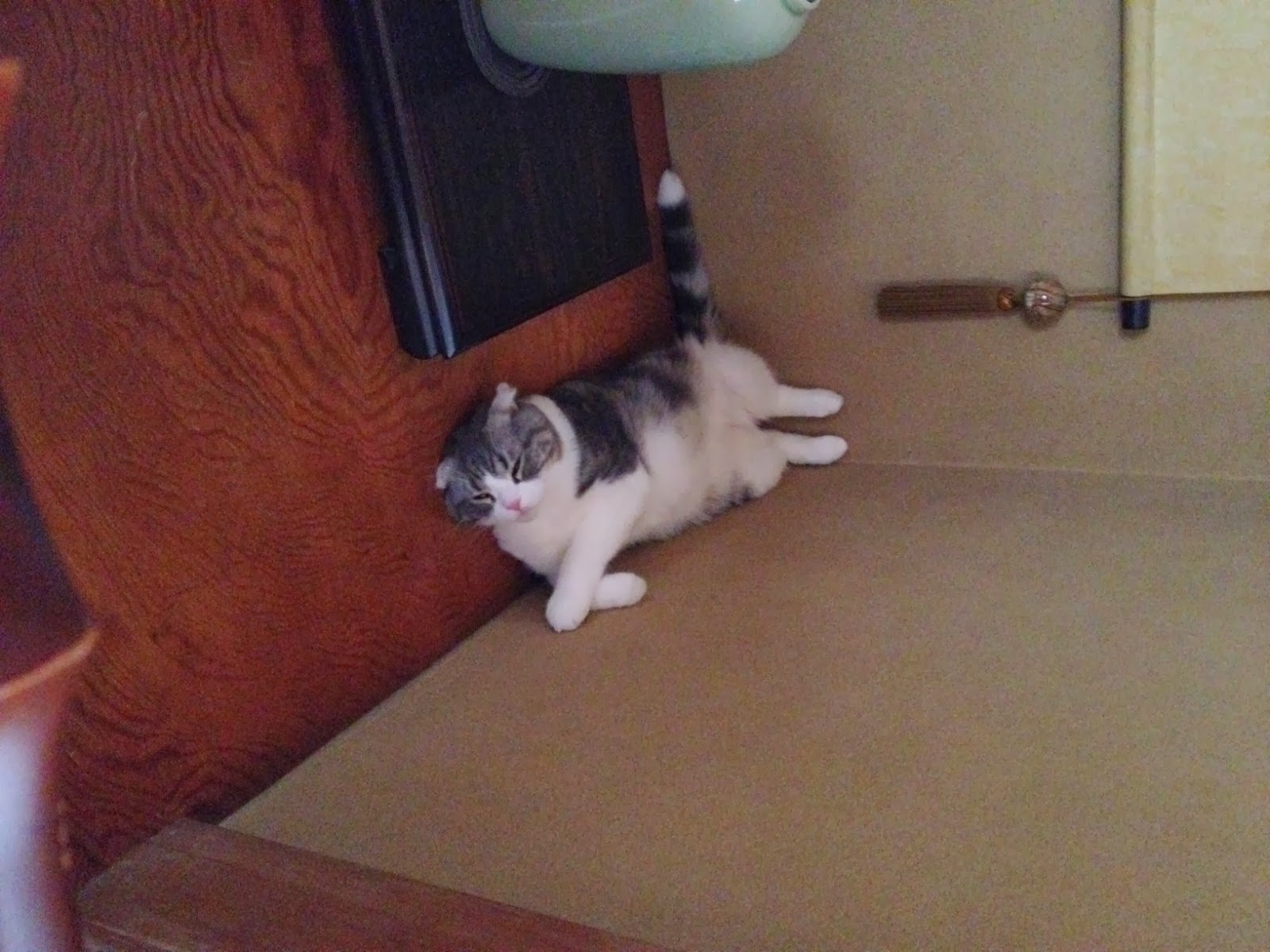
Saturday, December 7, 2013

Goo stories #33


            While watching Ren stretch, I licked my nose. "I had Maru captured!"
            Ren appeared to be an ant from this vantage point. He was so far away, and I no longer had any bouncy balls to give chase. The smell of burning fish had vanished along with the fire in my stomach. The room felt colder.
            I swallowed. "We could have brought him to justice!" Not kill him in cold blood.
            "Justice?" Ren laughed. "The only justice Maru deserved was death!"
            With my eyes closed, I shook my head. "No one deserves death."
            "Maru did."
            "Ren ... what happened?"
            Tears glistened Ren's eyes. "Maru murdered my younger sister when we raided his Fortress of Precision."
            I started. "Haro is dead?" Bile rose into the back of my throat. Besides Mom, Haro was the most beautiful creature I had ever seen. "That can't be true."
            Ren turned away from me. "It is."
            "Why did you never tell me?"
            "I figured it would be best if you didn't know." Ren shrugged before taking a step away from the house. "You might have figured out what I wanted to do if I did."
            "Ren!"
            After waving his war, Ren sprinted off into the distance.
            When Ren vanished from my sight, I slumped to the ground. I need to ... .


Next: Part 34


Friday, December 6, 2013

Guest post #1


7 Ways to Write the Journey
By Yvone Williams


When writing contemporary fiction, you’ll often find this one “rule” stifling your story: Do not write traveling scenes– readers don’t want to be bogged down by your character’s journey. This is a lie, and it’s the same lie your parents told you when you asked them where babies came from.

Showing the journey your characters make is a lot like having sex: Yes, your story could get AIDs, but if you play it smart, it can be a wonderful experience for all involved. Travel scenes do have the potential to kill your story, but only if there’s no conflict. Keep the reader engaged by using these 7 tools in your travel scenes:
1. Inner thoughts about the present.
Let us see who your character is and why they’re the protagonist instead of That Guy Bob. What are their opinions on their surroundings, and how do these surroundings affect your character differently? This is a great time to hint at impending conflicts and show us what your protagonist wants:

Maybe your story’s external conflict is survival in a dystopian world. As they travel past a field of crops, do they brood about their distaste for a particular crop because it’s a reminder of the society’s nefarious intentions, yet the townfolk mindlessly devour it?

Maybe your protagonist’s inner conflict is overcoming the death of their father. As they travel through the forest, do they curse the sight of a boulder, which most people wouldn’t think twice about, because it’s where their deceased father sharpened his blade every day?


2. Inner thoughts about the recent past.
This works best if your journey occurs after a high tension scene. In those scenes, you avoid breaking up the flow of action and your characters are making decisions on impulse. The journey they make after these moments are great for filling in the “why”s and showing the reader the emotional impact of that scene.

Along the journey, have your character question why they reacted the way they did and let them make judgments about it. How do they feel about the choice they made? Was their choice misguided, and if so, was it by something tangible or emotional? Does your protagonist know and accept what their actions say about them, or are they in denial?


3. Dialogue and character interaction
Show us the diversity of your characters by allowing them to interact along the journey. Each character will have lived a different life, and their experiences have shaped the way they view the world.

Introduce something they can react to– some element or event along the journey that will show how their perceptions and ways of problem-solving differ or clash. (Earn bonus points by creating an event that serves as a subplot.)

If the reveal of their opposing views doesn’t immediately create conflict between them, don’t worry– it’ll pay off later in the story when you reveal whether those opinions influenced the characters in a way that was beneficial or detrimental. This is why tertiary characters exist; their job is to influence your protagonist.


4. Pathetic fallacy
Pathetic fallacy is a type of personification that mirrors the mood of your character. Because this literary device is more commonly found in poetry than genre fiction, you want to be careful not to use it in a way that will induce laughter or eye-rolling.

Use it sparingly and avoid trying too hard. If you want to play it safe, save it for the Third Person POV; you don’t want your First Person POV character to seem overly dramatic by having them say “the sky wept…” if that’s not the way they regularly describe the world.

This device works wonders on a Third Person POV: Some readers prefer Third Person because First Person is too intimate. With that said, a common complaint about Third Person is that it’s too detached.

Pathetic fallacy is a great way to combat the distance between the reader and your characters, and maintain that balance between detachment and intimacy. By providing an inanimate object to relay the emotions of your character, you make it easier, for those who like detachment, to connect with the character on an emotional level.


5. Signpost Foreshadowing
A signpost, or plant, is a cue to the reader that something big is going to happen. You can foreshadow through dialogue, action, or thoughts, allowing a character to show potential for their future deed (or misdeed.) Foreshadowing along the journey allows you to keep the tension high– even if there’s no obvious conflict present in the scene.

K.M. Weiland, author of Dreamlander, can show you the right way to foreshadow.


6. Descriptive Foreshadowing
Unlike foreshadowing with signposts, you don’t have to hint that there will be a problem– you can tell the reader exactly what the problem is and the major obstacle that stands between success and failure. The reason you get to say all of that is because it’s wrapped up in symbolism and disguised as descriptive narrative.

Foreshadowing through description makes your narrative work overtime. Not only are you stimulating the 5 senses to transport the reader to your story world, showing off those world-building/research skills, and setting the mood, you give your story some serious replay value (for the non-gamers out there, that means people will read your book more than once.)

Create a symbol such as a bird, a handbag– whatever makes sense for your story problem– and have it reoccur. Tell the reader what they can expect to happen by the way you choose to describe that object and the way it interacts with its surroundings.


7. Dramatic irony
This works best if used just before your character makes a journey. Revealing a crucial piece of information to your audience, but withholding it from your character, allows you to maintain a sense of tension along the trip. Show us the trap that lies at the end of the road. Tell us your characters’ secrets or motivations– the ones they’re not telling the others.

Using dramatic irony just before the journey will have the reader dying to flip the page, but unable to do so any faster than they can read, as they wonder when and how the information will come to light. Just make sure the information serves its purpose by the end of the story, or you’ll find your book in the local yard sale bin.
Now what?
 
Now that you have 7 tools in your kit, your job is to write the journey– make it engaging, keep the tension high, and maintain that suspense! Just remember that the same rules apply to your traveling scene as any other: length should be proportionate to importance. So have fun with it and consider this list your 98% effective condom.


Yvone is a writer of Fantasy and Mainstream fiction. She is also a blogger, beta reader, and a participant of NaNoWrimo. For more writing advice, check out her blog at FetchingFigment.

Thursday, December 5, 2013

Teaching in Japan #2

Today, I'll focus on teaching at an elementary school as an ALT. This is the busiest of the three ALT positions, but it's the most rewarding in a way as well as the one with the most freedom to teach how you please. That also makes it rather difficult considering you have to make all the lesson plans.


I'll begin with the basics. Classes at an elementary school are 45 minutes long with a ten minute break between classes. Normally, there is a quick morning recess between second and third period as well as an afternoon recess between lunch and fifth period. These classes require a lot of energy. It's about 90% energy, 9% preparation and 1% dealing with random issues that arise in class. You need to be bouncy with a booming voice because the kids feed off of your energy. If you trudge into class, they won't get into it. No matter how fun 'should' be.

Next, I'll give you the basic outline of my elementary school lesson plan, then give details to each part. Though, each part is not set in stone depending on the topic, and how many times we have done the topic. Normally each topic has four lessons: Introduction > Expansion > Practice > Happyo (kind of like a mini presentation of what they've learned). Though, some topics require 5 lessons and some only 3.
-The introduction is where we introduce the new topic and play a lot of games with it.
-The expansion is where we review the previous lesson, then build on it before using it in a game.
-The practice is where we review both topics, play a quick review game in the middle and then prepare them for the Happyo.
-The happyo is where each student gives their presentation. Generally, they practice a bit at the start. If time allows, a generic game can be used to refill their energy. It's best if the game is related to the next topic though.

The basic outline - Introduction:
1 min Greetings (Sometimes takes longer)
3 min Songs (Sometimes takes longer)
5 min chants (Sometimes shorter)
2 min ABC writing (Use a timer)
1 min Review
5 min Introduce new vocabulary and have students check meaning
5 min Introduce new grammar and have students check meaning
2 min Interview game using new grammar and vocabulary
2 min Practice new grammar again
1 min Use grammar in a fun way to interact with students
2 min Practice new grammar yet again
3 min Quick game to use new vocabulary
3 min Quick game to use new grammar
10 min Main game or activity

The basic outline - Expansion
1 min Greetings
3 min Songs
2 min Chants
2 min ABC writing
2 min Review previous vocabulary
2 min Review previous grammar
1 min Interview game with reviewed grammar
2 min Review previous grammar again
5 min Introduce new grammar and have students check meaning
5 min Interview game with new grammar
2 min Practice new grammar again
1 min Use new grammar the same as last time to interact with students
2 min Practice new grammar again
15 min Main game

The basic outline - Practice

1 min Greetings
3 min Songs
2 min Chants
2 min ABC writing
2 min Review previous vocabulary
4 min Review previous grammar
2 min Interview game with reviewed grammar
2 min Review previous grammar
10 min Main game (sometimes shorter)
10 min Prepare for happyo
7 min Practice happyo

The basic outline - Happyo

1 min Greetings
3 min Songs
2 min Chants
2 min ABC writing
2 min Review previous vocabulary
4 min Review previous grammar
1 min Example happyo
5 min Practice happyo
3 min Practice race
2 min Practice happyo
20 min Happyo


Those are the basic outlines for the four lessons. But what do they mean?

Greeting is simple: The students stand and bow.
-Good morning/afternoon, everyone. > Good morning/afternoon Travis-sensei.
-How are you? > I'm fine, thank you, and you? > I'm wonderful today!
-How's the weather? > It's sunny.
-What's today's date? > It's Friday, December 25th
-What's up? > Studying English!
-Then they sit down.

Songs: Depends on the lesson and the monthly assembly song, but sometimes we can have fun with it. I actually had my kids singing "The Fox" for a while lol.

Chants: Depends on the lesson, but I use something called the Nori Nori chants, which are awesome.

ABC writing: This takes a lot of your time, but I made how to write the ABCs books for all my students, so every day they have a chance to practice and at the start of every class, as well.

Review: Just repeating something from the previous lesson to make sure they remember it and are saying it correctly.

Introduce new vocabulary: Using picture cards with the English words written across the bottom, You reveal the card and see if anyone knows what it is. If they do, they'll shout it out within a few seconds. Don't waste time quizzing them. Then repeat each word 3 times. Ask if anyone knows the Japanese for the word and have one student stand up and tell everyone what the word is in Japanese. Then repeat 2 more times. Do this for all vocabulary. Because of this, I'd avoid using much more than 10 new vocabulary per lesson, though sometimes it can't be helped.

Introduce new grammar: Using the picture cards, you use the grammar to create a sentence. First you ask if anyone knows what it means. If they don't, then you add gestures and try to make it easy for them to understand. A last resort is to have your JTE or you yourself translate the meaning for them. Then you have them repeat the grammar part only 3 times followed by saying it 1 time with each picture. After that, you repeat the grammar part 2 times and 1 more time with each picture.

Interview game: Using a timer, set two minutes on the clock after doing a demonstration with yourself or your JTE. Basic: Hello > Hello > Grammar sentence > Grammar sentence > Goodbye > Goodbye > Find another person. Tell them to get as many people as they can within the time ask them at the end how many people they talked to. Then ask them how many of them talked to you and see if you won or if they won.

Repeat each grammar: Repeat each grammar sentence one more time.

Using the grammar in a fun way: This can be anything. From a class poll to a walking around the classroom and picking up something off of a student's desk and asking another student, is this your pencil case? Just something to show the students how to use the grammar and that they can have fun with it.

The two small games will depend on the lesson. Sometimes it's 1 medium game and 1 large game or just 1 super large game. But this can be anything from the keyword game to the bomb game to the interview game with Janken-Zombies. Just something to have them practice in a fun way.

The main game is what your goal of the lesson is shooting for. It's to help the students compete to use the grammar to win the game. This will take up 99% of your preparation time.

Preparing for the happyo and the happyo: You tell the students that they have to use the grammar and the things they've been saying in the interview game, to make their own little speech in front of the classroom. Sometimes, it is done by groups. Sometimes, it is done within groups. Depends on the lesson. 90% of the time, you will have the speaker say Hello > and have the class respond Hello. Then they will say their name: My name is Travis > then you have the class use one of the grammar points. After that, the student gives their speech and ends with: Thank you. The class claps, and the next student comes up. So you let the students think about their topic and help them with pronunciation to make sure they get it right.

Practicing for the happyo: Kids repeat the parts that don't change. Then you have them repeat while filling in the blanks two times. Then you have them stand up and read their happyo three times before sitting back down. Finally, they repeat while filling in the blanks one more time.

Happyo race: This is where the kids of a row or column compete to see which one is fastest. The first person stands up and reads his happyo, when he sits down, the next person stands and reads theirs until it reaches the end. I do from the front to the back. From the wall to the window. From the back to the front. And last from the window to the wall.


That's the basics of teaching a class and preparation. Later on, I'll go over some more specific details.

I hope this helps.

Thanks for reading,
Travis


Next: As an ALT at a junior high school 


Wednesday, December 4, 2013

Teaching in Japan #1

Today, I'm introducing a new segment to the blog called Teaching In Japan. It will focus on teaching English as a second language and include lesson plans I've used, how to make a lesson plan for a class and games I really like to use in my classes.

I'll try to be as detailed as possible with each topic, but if you feel like something is missing, please comment or make a request, and I'll try to come up with something that will fit your specific question/need.

As far as my background outside of writing is concerned, I graduated in 2008 and came to Japan soon after that. I started out working as a high school ALT then moved to an international kindergarten, a little bit of Eikaiwa work and finally settled down as an elementary school and junior high school ALT directly hired by the Japanese government. (The Board of Education — BOE — in the city I work in) I've taught private lessons for all levels and have done part time work over the course of my time here.  I'll get this out of the way ... there is no future in teaching. Have other goals you want to accomplish here. You "can" survive while teaching and save money as well as plan for retirement, but I wouldn't recommend that. As for me, I'm trying to become a published author.


There are many places I could start, but I believe I should begin with punctuality. In Japan, early is 20 minutes before your scheduled time. 10 minutes before your scheduled time is 'on time.' If you arrive at your scheduled time, you are late. It's just the way they work. Sure, if you are there before you're supposed to be, they won't say anything to you directly, but they will complain to the people in charge of you with things like, "He clearly doesn't care about his job," or what not, and your life will become miserable. The more often you do this, the more the other teachers will treat you differently.

Why is this?

Well, in Japan, there isn't really the excuse of, "I was stuck in traffic," since everyone rides the trains. And the trains are deadly precise. They generally arrive and leave within the first half of the minute they are scheduled to be at the station. Everyone has a set time that they will get on the train as well as they know a good estimate of when they'll arrive. And if there is a train delay? Before you exit the station at your final stop, go to the ticket booth and ask for a 遅延証明書 or 証明書 for short (sounds like show-may-show), and they will give you a small piece of paper. Give this to the person in charge, and it is no worries for being late.

Advantages of being early? Well, for starters the people you work with will get along with you better. Other than that, you have a breather to settle yourself in before the crazy day of work begins. Finally, you build up credit for those rare occasions that you do end up late without a valid excuse.

Speaking of excuses, don't give them. Japanese people don't want to hear them. It doesn't matter why you are late — unless you have a 証明書 — it just matters that you are late. Say you're sorry and move on.


Now that we've got the basics of keeping your working relationship with Japanese people healthy, let's move on to our teaching options. The big two are Eikaiwa (small, private English schools) and ALT (Japanese public schools with large classes). Both have advantages and disadvantages. Like an Eikaiwa, there are also international kindergartens. I'd try to avoid those as they are very high maintenance, stressful and more work than pay.

I'll start with Eikaiwas. They can be great. Though, they often have more work than an ALT job as well as a lot more stress. Starting salary will be higher than starting ALT salary, thought the top end per day of work is about the same. The only problem with the calculation is that most ALT jobs don't work during August, thus no pay, therefore, yearly, Eikaiwa jobs will pay more. What that doesn't tell you is that Eikaiwa jobs work 2 to 3 hours more a day than ALT jobs.
-Pros: Higher yearly salary at the start
          Easy to follow, pre-planed lessons
          A sense of satisfaction that your students are learning
          Easy to enroll in pension
-Cons: More working hours
           More stress
           No long summer holiday
           Busy from start to finish (Some people consider this a pro)
           Speaking nothing but English all day

Next, we have ALT work. This is really divided into two groups: high school and elementary/junior high school. Both will have you teaching at different schools throughout the week. High school is two different high schools. Elementary/junior high school is generally one of each. The basic working hours are the same, but high school pays less because you only end up doing about 3 hours of work a day. Unless you are hard at work doing something else, it is mind-numbingly boring. One the other hand, elementary/junior high school could have you working all 6 hours that you are there like an Eikaiwa, but the pay is higher. The key word there is could. At my elementary school, I find myself working 11 of the 12 hours that I'm there over two days, but it's only 2 days a week, and when they have events, classes are cut down. At my junior high school, I work about 14 of the 18 hours that I'm there over three days. Exams are like a week of 'come to work and sit in the teachers room until it's time to go home,' and I love it since it gives me a lot of time to write. Working hours for an ALT are generally 8:30 to 3:30 (4:00 in high school)
-Pros: Great working hours
          No stress
          A long summer holiday
          Free time during work to do the things you want to do
          Good place to practice Japanese with the other teachers
          Fun interactions with the students and teachers
          Enough free time to pick up a part time job or private lessons 
-Cons: Low starting pay (until you are directly hired)
           Insecure location (until you are directly hired)
           Difficulties with pension
           No satisfaction from students learning as they generally don't retain anything
                  -(Japanese system, though I'm trying to change that in my classes)
          Often times part-time work is required
          Must make and prepare own lessons (can be a pro) 


For me, ALT is the way to go, but others may see things in a different light. I'd research the Eikaiwa you're thinking about before signing a contract. For ALT work, research the dispatch company. If you can get direct hire, do that. Better pay, fewer hours? Is there really another choice?


The final thing I want to mention in this post is that you have to through your pride away. At least in the classroom, be a clown. Put on a show and make the kids smile. Do stupid things that you otherwise would never be caught dead doing. At first shout, but learn to control your voice where it's big, projected and everyone on the same floor can hear you clearly ... this one can be funny sometimes lol. Don't be afraid to dance in class no matter how bad you are at it. Also, slow your speaking down a bit and add a brief pause between sections of the sentences you read or instructions you give to allow the children to process the information while they go.

Next time, I'll get into the meat of teaching. I'll go over how I prepare materials and what a general lesson plan outline of mine looks like for an elementary school.

I hope you enjoyed reading, and I hope you found this useful
Travis


Next: As an ALT at an elementary school 


Tuesday, December 3, 2013

Writing resource #14

So, today I want to spread the resources that I've recently come across that go by "The death of thought verbs!" Not quite what these three sources call them, but it's pretty accurate. To sum them up, thought verbs are short cuts or word padding. They should be eliminated and replaced by showing the reader what those 'thoughts' actually were.

Writing Excuses — the episode that talks about it in the latter half.

Chuck Palahniuk — the original thought verb article (for me).

Seek and destroy — an easy to access list of thought verbs.


With these three resources, I've been able to show more in my writing and help convey more feelings than ever before.

One thing I did learn though, you should still tag thought paragraphs. Not with an introductory sentence using a thought verb — that's padding. But with a quick: Images of xxxx, or In his thoughts/mind, xxxxx or When he closed his eyes, xxxxxx. Something to show the reader that it isn't actually happening around them.

Then, the rest of the paragraph can display that thought. The next few paragraphs can continue the thought, but if you do that, you should tag when the character comes out of the thought. Like: Then, he opened his eyes and xxxxx or Once reality returned, xxxxx or Back in the present, xxxx or anything that actually would bring your character back out of his thoughts.

I hope this resource helps you as much as it did me.

Thank you for reading,
Travis


Next: Body Language Cheat Sheet 2


Monday, December 2, 2013

Goo stories #32


            I met Maru in midair and grunted. While turning my weight, I threw him off balance and sent him tumbling to the floor. With a flare of my stomach oven, I rebounded off of the far wall. "Over already?"
            The haze of blackened fish was so heavy that I could taste it. When Maru's eyes began to glow, I fell to the carpeted floor. The energy around my body was gone. My bouncy ball had somehow broken earlier than it should have.
            Unable to hide my fear, I trembled. "What ... did you do?"
            Once his eyes stopped glowing, Maru panted. "Did I do something?" A smile crept across his creepy face.
            It has to be that oversized toy in his bag. I grabbed onto a squeaky toy and lunged forward.
            Maru's eyes began to glow again.
            Crack!
            I felt my squeaky toy shatter. "That's ... impossible!"
            Maru labored for breath. Each step he took seemed to drain more and more of his energy. "It's time I end this."
            If he has the power to destroy my toys, why hasn't he destroyed all of them yet? After biting into my lower-lip, I stepped backwards. "I reached out with my mind. Three toys left: two stick-and-feathers as well as a squeaky-mouse toy. A plan formed in my head.
            While narrowing his eyes, Maru purred. "Scared? That's perrrrrrrrrrrrfect." He moved forward.
            Without thinking, I charged Maru. I hope this works! I reached out and grabbed the stick-and-feather toy.
            Maru hissed.
            Once I saw his eyes begin to glow, I released my hold on the toy and ran headfirst into him. He grunted. We both tumbled to the floor.
            Thump.
            Thump.
            Thump.
            My stick-and-feather was still intact. I was right. "You lose, Maru!"
            "I--"
            I grabbed onto the stick-and-feather. My fur grew and spikes ripped into Maru's flesh.
            Maru screamed.
            I released the toy and slapped him across the face with my paw. I bit into his left arm. When the coin-like taste of blood filled my mouth, I leaped to the side and grabbed the squeaky-mouse toy.
            Maru rolled back to his feet. "I'll--"
            After spitting the blood out of my mouth, I extended a massive claw, grabbing Maru's toy bag and tossing it across the room. That should be far enough away that he can't touch it. A second claw grabbed him by the chest and slammed him into the wall opposite his toys.
            Maru coughed. Tears formed in his eyes. "Goo ... please ... I never--"
            Another hint of burning fish entered the air.
            I blinked.
            A thin beam ripped through the wall and pierced Maru's heart.
            My eyes bulged. "What?"
            Ren strolled in through the same door I had used and grinned. "Now ... it's over." He sprinted across the room before scooping up Maru's toy bag and leaping out the window.
            "Ren!" I sprinted to the window and glared down at my friend. "What's the meaning of this?"


 Next: Part 33


Sunday, December 1, 2013

Blog update #1

So, now that NaNo WriMo has come and gone, I'm no longer cutting everything else off in my life. I have a few critique request pending, but with the Goo story's first season coming to a close, I'll be looking for more pieces to critique or new writing resources.


If you'd like me to critique a chapter in your story, please email me a copy of it in .dos/.dosx format or just copy it to the body of the email to travis.sullivan (at) gmail (dot) com (no spaces and use the @ and a .) or just copy/click this.

Beyond whatever things you would like me to focus on, I try to check for grammar and spelling mistakes (both are not my strongest suit, but I'm okay with them) first. After that, I go through and write down my opinion line by line, sometimes giving suggestions for a fix. At the end, I give my overall opinion of the chapter, what I liked, what I didn't like, would I keep reading in the current state, and if that answer were no, what changes would need to be made in order to have me continue reading if I were a reader. (I'm not saying if I would continue critiquing as I generally only do a few chapters of most people's works for critiques unless they are also critiquing my work)

Everything I write is my opinion and my opinion alone. Please don't take the comments personally, and if the changes or complaints aren't something that you think is necessary, just ignore them. You should only use what you think is best for your story as it is just that, your story.

For an example of my work, please check out my first critique.

On critiques, I'll email you a copy about a day before I post it. When you make changes and edit, feel free to send me the updated copy as well as some responses to my questions and comments, and I'll be happy to critique it again. This will show readers what you have taken away from the first critique and how things have improved, thus helping them improve their own writing. 


I look forward to checking out your submissions,
Travis Sullivan